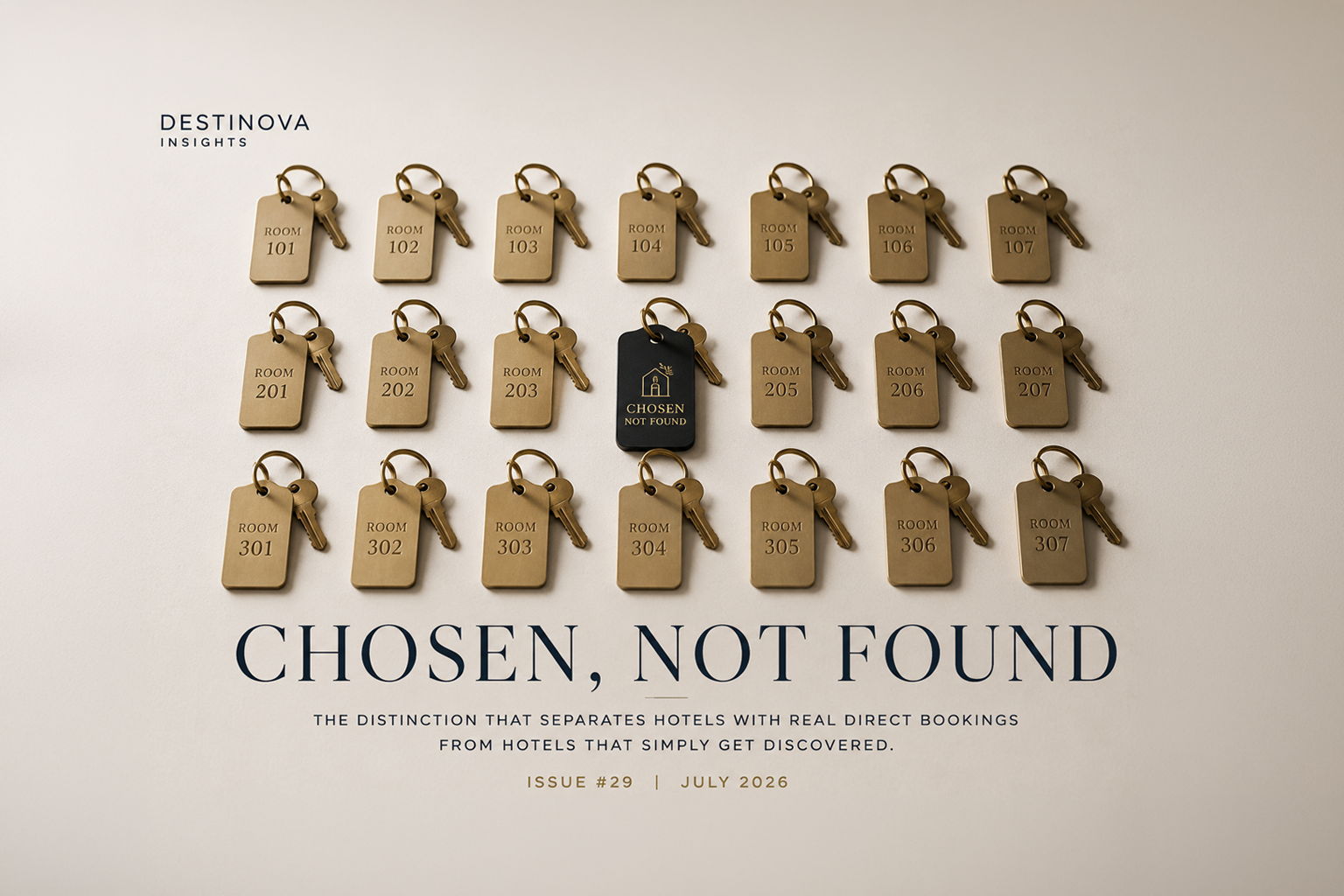
A marketing strategist recently summarized the biggest challenge in hospitality with just five words: “Chosen, rather than found.”
It sounds like a subtle distinction. It isn’t. It’s the difference between a hotel that owns its future bookings and one that rents them from whoever controls the discovery layer that week.
Being found means a traveler lands on your property because an OTA surfaced it, an ad interrupted their scrolling, or a search engine ranked you above three alternatives.
Being chosen means something entirely different. It means the traveler was already looking for you. Not because you happened to appear first, but because your hotel had already earned a place in their mind before they were ready to book.
Most hotels spend enormous effort becoming easier to find. Very few invest enough in becoming impossible to forget. And that’s where the real difference begins.
If OTAs disappeared tomorrow, how long would your bookings continue? The answer tells you whether guests choose your hotel — or simply find it.
Why This Matters More Than It Seems
In the short term, being found and being chosen produce the same result. A room gets booked. Revenue arrives. The monthly report looks healthy. But over the next twelve to twenty-four months, they create two completely different businesses.
Guests who merely find your hotel often struggle to remember its name a few weeks later. They booked a hotel in Naxos. Not your hotel. Guests who choose you remember exactly why they did. They recommend you. They return. Before searching for alternatives, they first check whether you have availability.
There’s another important difference. Guests who find you usually come at the cost of commissions, paid acquisition, or algorithmic visibility. Guests who choose you come from brand equity. One expense resets every month. The other compounds over time.
Hotels built on discovery become vulnerable every time an algorithm changes. Hotels built on recognition remain resilient through seasonality, platform shifts, and market uncertainty. That’s why the hotels that continue performing in September, February, and every quieter month are rarely the ones with the biggest advertising budgets. They’re the ones guests remember.
A Three-Question Audit
If you want to know whether your hotel is being chosen — or simply found — start here. Answer these three questions honestly.
1. How many people actively search for your hotel’s name?
Open Google Analytics. Then review your branded search queries in Google Search Console. How many visitors search specifically for your hotel’s name? Not “boutique hotel Santorini.” Not “family resort Crete.” Your name.
If branded traffic represents less than 15% of your overall traffic, your business still depends largely on discovery. If it’s above 30%, your positioning is beginning to create genuine brand demand.
2. How many bookings arrive without paid influence?
Look at your direct and organic bookings. No paid campaigns. No OTA referrals. No email campaign. No retargeting. These are the guests who decided on your hotel before anyone reminded them to.
If that segment represents less than 20% of total bookings, you’re paying to acquire almost every guest. If it’s closer to 40%, your brand is beginning to generate demand on its own.
3. Why do guests say they chose you?
Read your last fifty reviews. Ignore the ratings. Read the language. Do guests describe generic reasons? — “Great location.” “Friendly staff.” “Good value.” Or do they remember something unmistakably yours? — “The breakfast under the olive tree.” “The owner who welcomed us at the harbour.” “The quiet cove five minutes away.”
Specific memories are the strongest evidence that your positioning exists long before the booking happens. And that’s exactly what brings guests back.
Being chosen doesn’t require a bigger marketing budget. It requires greater clarity.
What Being Chosen Actually Requires
The hotels that build lasting demand tend to make three strategic shifts.
1. Stop trying to be for everyone
One of the biggest mistakes in hotel marketing is attempting to appeal to every type of traveler. Families. Couples. Digital nomads. Luxury seekers. Wellness travelers. Solo explorers. The result is predictable — messaging so broad that nobody remembers it.
Hotels that are consistently chosen do something different. They know exactly who they’re for — and they’re comfortable saying it. Try completing this sentence: “We are the hotel travelers choose when they want ______.” If you can’t answer it in one clear sentence, you don’t have a marketing problem. You have a positioning problem.
2. Give travelers something worth remembering
People don’t remember categories. They remember moments. Images. Stories. Specific details. “Boutique hotel” is a category. “Breakfast beneath the century-old olive tree” is a memory. “Sea-view suites” is generic. “The hidden cove only guests know about” is memorable.
Every hotel already has details like these. Most bury them beneath endless lists of amenities. The hotels that get chosen do the opposite. They bring those details forward — into their hero image, their first headline, their emails, their social content. Because memory isn’t created by facilities. It’s created by specificity.
3. Stop competing for discovery. Start competing for recognition.
The OTA ecosystem is designed to keep hotels in a permanent cycle of being discovered. Every euro invested solely in OTA visibility strengthens the platform’s brand more than your own. Hotels that become chosen gradually redirect part of that investment toward assets they actually own: their audience, their email database, their content, their brand search, their guest relationships. None of these deliver overnight returns. But unlike paid visibility — they compound.
The September Test
Last week’s Destinova Insights argued that peak season hides your real positioning. September reveals it. This week, we can be even more specific: September tells you whether guests truly chose your hotel — or simply found it.
Hotels that maintain momentum after August usually have one thing in common. Guests remember them. Search for them. Recommend them. Return to them. Hotels whose pipeline collapses often discover that much of their summer demand belonged to the market — not to the brand.
Over the next six to eight weeks, every hotel will receive an honest answer: how much of your business is driven by recognition? And how much depends entirely on someone else’s algorithm?
You can’t rent brand recognition. You can only build it. And hotels that never build it eventually end up renting everything else too.
What To Do This Week
Open the About page on your hotel’s website. Read only the first paragraph. Then ask yourself one question: if this were the only thing a traveler read, would they immediately understand what kind of experience we offer — and why we’re the right hotel for them?
If your answer is “Sort of.” “It’s implied.” “Hopefully.” — you’ve just found your next marketing priority. Hotels that are remembered don’t hide behind generic language. They make a clear promise. They define who they’re for. And they give travelers a reason to remember them.
Worth Asking Yourself
If travelers could no longer search for “boutique hotel in Greece” tomorrow — and could only book hotels they already knew by name — how many would remember yours? The answer to that question is probably the clearest measure of your brand’s true value.