Over the past two weeks, we’ve traced the same argument through two different lenses.
Issue #29 made the distinction: hotels are either chosen or simply found. Issue #30 priced the difference: being found isn’t cheaper — it’s just deferred payment, and the interest compounds.
Which leaves the obvious question: how, exactly, does a hotel become chosen? Not in theory. In practice.
Because “build a stronger brand” is not a strategy. It’s a bumper sticker.
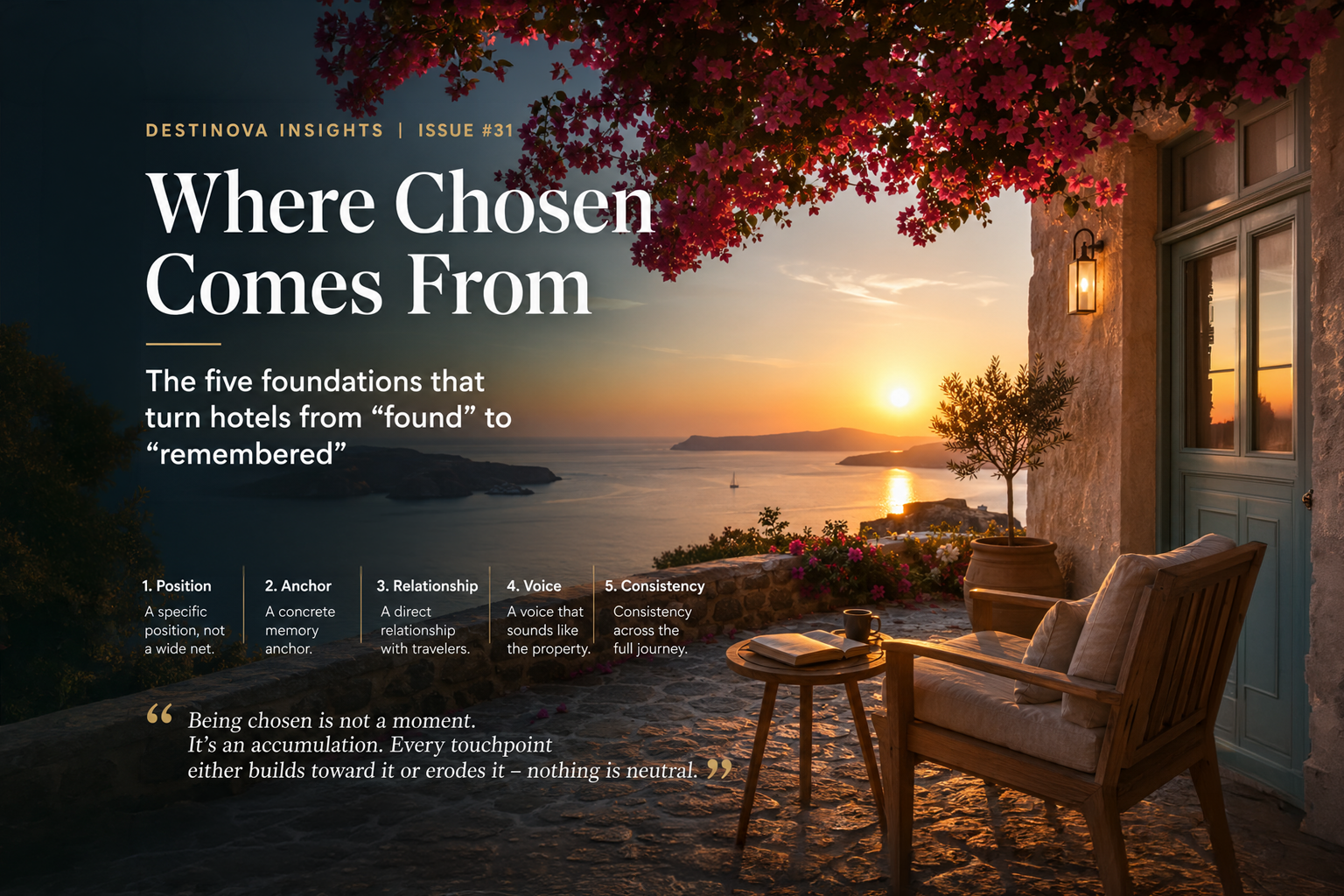
The hotels that actually generate direct bookings independent of algorithms don’t do it by accident. They build recognition on five specific foundations — each of which is buildable, measurable, and cumulative. Here’s what those foundations actually are.
Being chosen is not a marketing outcome. It’s an infrastructure — and infrastructure is built on foundations, not campaigns.
Foundation 1: A Specific Position, Not a Wide Net
The first thing chosen hotels have in common is they know exactly who they’re for — and they’re willing to say it out loud. Not “boutique.” Not “family-friendly.” Not “luxury for discerning travelers.” Actual specificity:
- “The hotel families choose when they want their children to explore Greek villages, not stay at a kids’ club.”
- “The property couples book when they want privacy, not photo opportunities.”
- “The place solo travelers pick when they want to disappear into a small island for two weeks.”
Every hotel that gets consistently chosen can complete this sentence in one line. Every hotel stuck in the “found” category cannot.
The reason is structural. Broad positioning makes memory impossible. When you’re for everyone, no specific traveler carries you in their mind between the moment they discover you and the moment they’re ready to book.
Practical test: Can your team, right now, agree on a single one-sentence answer to “who is our hotel specifically for?” If three people give three different answers, that’s the foundation to fix first — before anything else.
Foundation 2: A Concrete Memory Anchor
The second foundation is something specific enough to remember. Not “beautiful views.” Not “warm hospitality.” Not “authentic experience.” A memory anchor is a detail so specific that a traveler could describe it to a friend three months later:
- The 300-year-old olive tree in the courtyard where breakfast is served
- The owner who walks every guest to the harbour on departure day
- The private cove reached only from the property’s own path
- The reading library filled with books left by previous guests
Every hotel has details like these. Most bury them beneath amenity lists. Chosen hotels bring them forward.
The reason memory anchors matter: they’re what travelers actually recall when someone asks “where did you stay?” Categories don’t get remembered. Specifics do.
Practical test: If a former guest were describing your hotel to a friend, what’s the one detail they’d mention first? If you don’t know — or if the answer is generic — you haven’t given them anything to remember. That’s where positioning turns invisible.
Categories are what marketers write. Specifics are what guests remember.
Foundation 3: A Direct Relationship With the Traveler
The third foundation is the one hotels most often skip — because it takes the longest to build and pays back the slowest. Chosen hotels own the relationship with their travelers. Found hotels rent it. Owning the relationship means:
- The hotel has the traveler’s email — not the OTA
- The hotel can communicate directly, at will, without an intermediary
- The hotel knows the traveler’s preferences from previous stays or interactions
- The hotel can invite the traveler back, offer new experiences, share stories, without paying acquisition cost again
None of this happens automatically. It happens when a hotel treats every guest interaction — booking, stay, post-stay — as an opportunity to build an owned audience.
Over five years, a hotel with 50,000 owned relationships and a hotel with zero look identical every month. Over the sixth year, they don’t.
Practical test: How many travelers can your hotel reach directly, tomorrow, without paying anyone for access? If that number isn’t growing every month, the foundation isn’t being built — it’s being borrowed.
Foundation 4: A Voice That Sounds Like the Property
The fourth foundation is often mistaken for design, but it’s actually linguistic. Chosen hotels sound like themselves. Their website copy, emails, social content, and guest communications all carry the same tone, the same vocabulary, the same distinctive rhythm — because they’re all written from the same underlying identity.
Found hotels sound like “any decent hotel would sound.” Generic warmth. Generic elegance. Generic promises of unforgettable experiences.
This matters because voice is what makes the positioning feel real rather than aspirational. A hotel can claim to be “the property couples book for privacy” — but if the website copy reads like it was written for luxury families, business travelers, and solo backpackers simultaneously, the positioning falls apart on first read.
Practical test: Take three pieces of your hotel’s written content — a website page, a marketing email, a social caption. Read them side by side. Do they sound like the same voice? Or three different marketers writing to three different imagined audiences?
Foundation 5: Consistency Across the Full Journey
The fifth foundation is what holds the other four together: consistency over time, across every touchpoint. Chosen hotels present the same identity from first impression to post-stay follow-up:
- The hero image and the actual property match
- The website tone and the check-in experience match
- The email newsletter voice and the owner’s personal reply match
- The story told before the stay is the story remembered after
Found hotels are inconsistent in ways that individually seem small but cumulatively erode trust. The website promises intimacy; the check-in feels transactional. The marketing highlights personal service; the follow-up is templated. The positioning claims exclusivity; the actual guest experience is indistinguishable from three competitors down the street.
Inconsistency is the fastest way to erase whatever memory the traveler was building of you. Consistency is how memory becomes preference — and preference is what “being chosen” ultimately is.
Practical test: Would a mystery traveler who booked, stayed, and received your post-stay communications come away with a single coherent impression of who your hotel is? Or several fragmented, contradictory ones?
Being chosen is not a moment. It’s an accumulation. Every touchpoint either builds toward it or erodes it — nothing is neutral.
The Uncomfortable Order
Here’s what most hoteliers get wrong when they try to build being chosen: they start with Foundation 4 (voice) and Foundation 5 (consistency) — because those look like marketing work.
But voice without a specific position is just polished ambiguity. Consistency without a memory anchor is just repeated genericity. The foundations have to be built in order:
- Position — decide who you’re for
- Anchor — surface the specific detail travelers will remember
- Relationship — build direct access to the audience that fits
- Voice — express the identity in your own vocabulary
- Consistency — maintain it across every touchpoint, always
Skip a step, and everything above it becomes decorative. Build them in sequence, and each one compounds the value of the next.
What This Actually Delivers
Hotels that build these five foundations consistently — over 12, 24, 36 months — end up in a different position than hotels that don’t. Not because they invested more budget. Because they invested it differently.
Their direct booking share can grow materially over time, reducing dependence on paid acquisition and intermediaries. Their September pipeline no longer collapses when August ends. Guests return without needing to be retargeted. And their pricing power grows because travelers compare them to memory — not to alternatives.
They stop paying to acquire guests they already had. They become chosen — and once that infrastructure exists, it compounds without needing to be rebuilt every season.
You don’t market your way into being chosen. You build your way in.
What To Do This Week
If the five foundations feel like a lot, start with only one. Foundation 1 is where every hotel should begin — because everything else depends on it. Sit down this week and force a real answer to this question: “We are the hotel travelers choose when they want ______.”
Not the answer that sounds nice. The answer that would make one specific traveler feel like you were built for them — and would make three other traveler types choose elsewhere. If completing that sentence is uncomfortable, that’s the signal it’s working. Every hotel that gets chosen has completed it. Every hotel that doesn’t, hasn’t.
The shift from being found to being chosen doesn’t happen in a campaign. It happens when hotels deliberately build recognition, memory, and direct relationships — season after season. That is the infrastructure behind sustainable direct demand.
Worth Asking Yourself
Of the five foundations — position, anchor, relationship, voice, consistency — which one is your hotel actually building right now? And which one has been unbuilt so long that it’s become invisible? The honest answer to those two questions is the difference between marketing that compounds and marketing that resets every season.