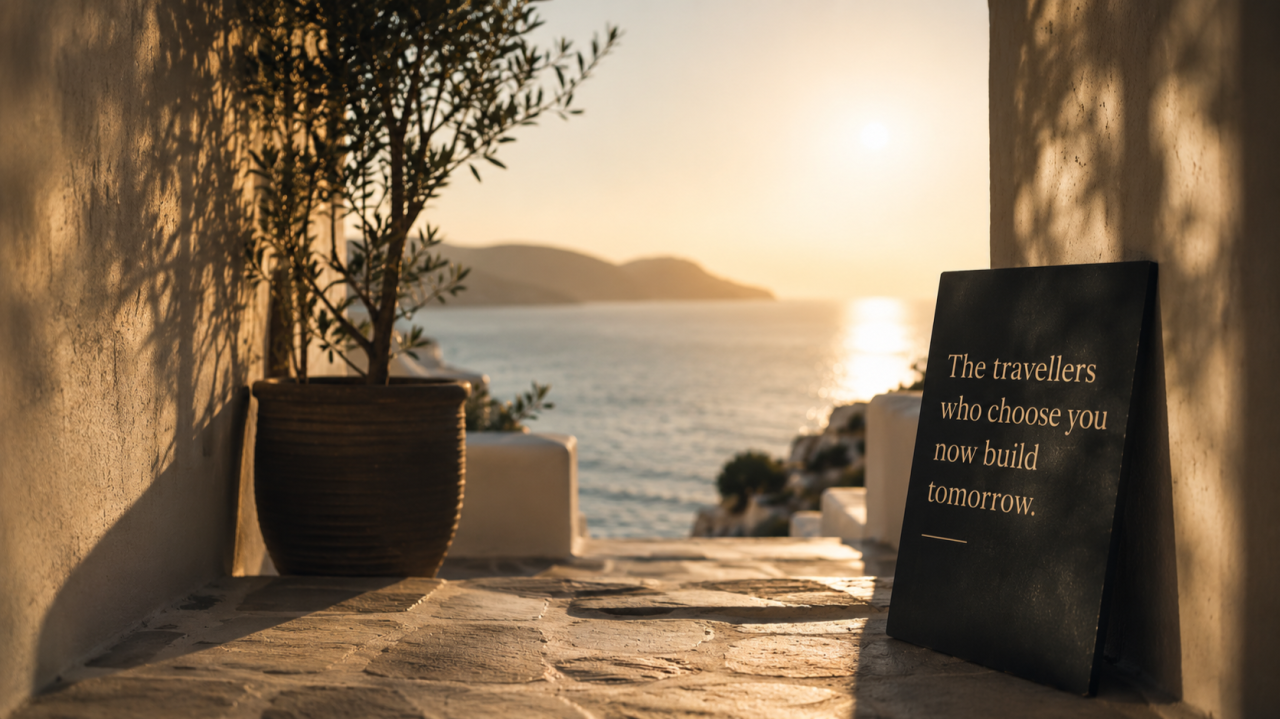
September has started.
For most Greek hotels, this is the month the year begins winding down. Occupancy softens. The team thins out. The conversations turn to closing dates and winter maintenance.
That framing is understandable. It is also backwards.
Because the travellers who arrive over the next eight weeks are, statistically and behaviourally, the most valuable guests your hotel will host all year.
Not the highest paying. Not the most numerous.
The most valuable — in the specific sense that they are the ones most likely to come back, most likely to book directly, and most likely to tell someone.
And almost every hotel treats them like the leftovers of a season that already peaked.
August guests fill the year you're in. September guests build the year after.
Who arrives now
Something changes in the composition of demand the moment peak season ends.
The traveller who books a Greek hotel for late September or October made a fundamentally different decision from the one who booked for the second week of August.
They had choice. Availability was open. Prices were negotiable. Dozens of properties were competing for them.
And they picked you anyway.
That single fact separates them from almost everyone who stayed with you last month.
The August traveller was solving a logistics problem: where can I stay during the two weeks I'm allowed to be away. The September traveller was making a preference decision: where do I actually want to be.
One is constrained. The other is deliberate.
Only the deliberate one tells you something about your brand.
The behavioural differences you can observe
This isn't a matter of intuition. Shoulder-season guests behave differently in ways your own system can show you, if you look.
They book further ahead. Without scarcity pressure, they plan. A longer booking window means they had time to research, compare, and decide — which means whatever made them choose you was strong enough to survive a few days of consideration.
They negotiate less on price. Not because they have more money, but because price wasn't the deciding factor. They came for something specific.
They book directly more often. They knew who you were before they searched. That's the entire definition of brand pull.
They stay longer. Off-season trips tend to be slower, less itinerary-driven, more about the place than the checklist.
They ask different questions. Fewer complaints about the pool being crowded. More questions about the village, the walk, the family that runs the taverna down the road.
They return. This is the one that matters. A guest who chose you when they had every alternative available has already demonstrated preference. Preference is what repeats.
The thing most hotels do instead
Here is what typically happens in the first two weeks of September.
Occupancy drops. Someone in the commercial team gets nervous. A discount goes out.
Sometimes it's a flash sale. Sometimes it's a rate drop on the OTAs. Sometimes it's an email to the entire August list with a code.
And the discount works, in the narrow sense that it moves some rooms.
But look carefully at who it attracts.
A price-led offer in September does not bring back the traveller who was going to choose you anyway. It brings a different traveller entirely — one who is now here because of the rate, and who will be somewhere else next year when someone else's rate is lower.
Meanwhile, the guest who was already coming — the deliberate one, the one worth building around — now knows your September price is soft.
You have taught your best audience that patience is rewarded with discounts.
That lesson does not expire.
A September discount doesn't fill the room you were going to lose. It devalues the room you were going to sell.
What to do instead, starting this week
None of this requires a campaign or a budget. It requires attention, in a month when you finally have some.
Notice who arrives. You have capacity to actually see your guests now in a way August made impossible. Which ones booked directly? Which ones have stayed before? Which ones mentioned a specific reason for choosing you?
Ask one question at checkout. Not a survey. One question, in conversation: what made you pick us? The answers you get in September are worth more than the entire August review set, because these guests made a real choice and can articulate it.
Write the names down. In Issue #34 we suggested noticing the quiet guests. This is the month to actually do it — and September's guests are disproportionately those people.
Keep talking through the winter. The relationship you form this month is worth almost nothing if the next contact is a booking prompt in April. The travellers who chose you deliberately will keep choosing you if you stay present — and will quietly drift if you disappear for six months.
Hold your rate as long as the calendar allows. Not out of stubbornness. Because your September price is a signal about what your property is worth, and your best guests are the ones reading it most carefully.
The shift this asks for
The hardest part of this isn't operational. It's how the months are framed internally.
Most hotels run on an unspoken hierarchy: summer is the business, and the rest of the year is what happens between summers.
Under that hierarchy, September is a wind-down. Staff attention drops. Standards slip slightly. Marketing goes quiet. The guests who arrive get a version of the hotel that is already half asleep.
Which is a strange way to treat the audience most likely to come back.
The properties that grow their direct business year after year operate on a different hierarchy. Summer is the revenue. Autumn is the audience. And the audience is what makes next summer possible at a lower cost of acquisition.
Both months matter. They just do different jobs.
Peak season is a transaction. Shoulder season is a relationship. Most hotels invest heavily in the first and improvise the second.
The quiet advantage
There's something worth sitting with here.
Your competitors are, right now, mentally checking out of the year. Their marketing goes quiet in September. Their follow-up stops. Their attention moves to the winter.
Which means the cost of being memorable drops sharply in exactly the months when the travellers most capable of remembering you are actually present.
That is not a small opportunity. It is arguably the largest one in the calendar, and it is available precisely because almost nobody takes it.
August is when hotels compete hardest for guests who were never going to be loyal.
September is when almost nobody competes for the guests who would be.
💬 Worth asking yourself this week
Of the guests arriving at your property in the next four weeks — how many of them will you actually remember by December?
And what would need to change for the answer to be more than none?