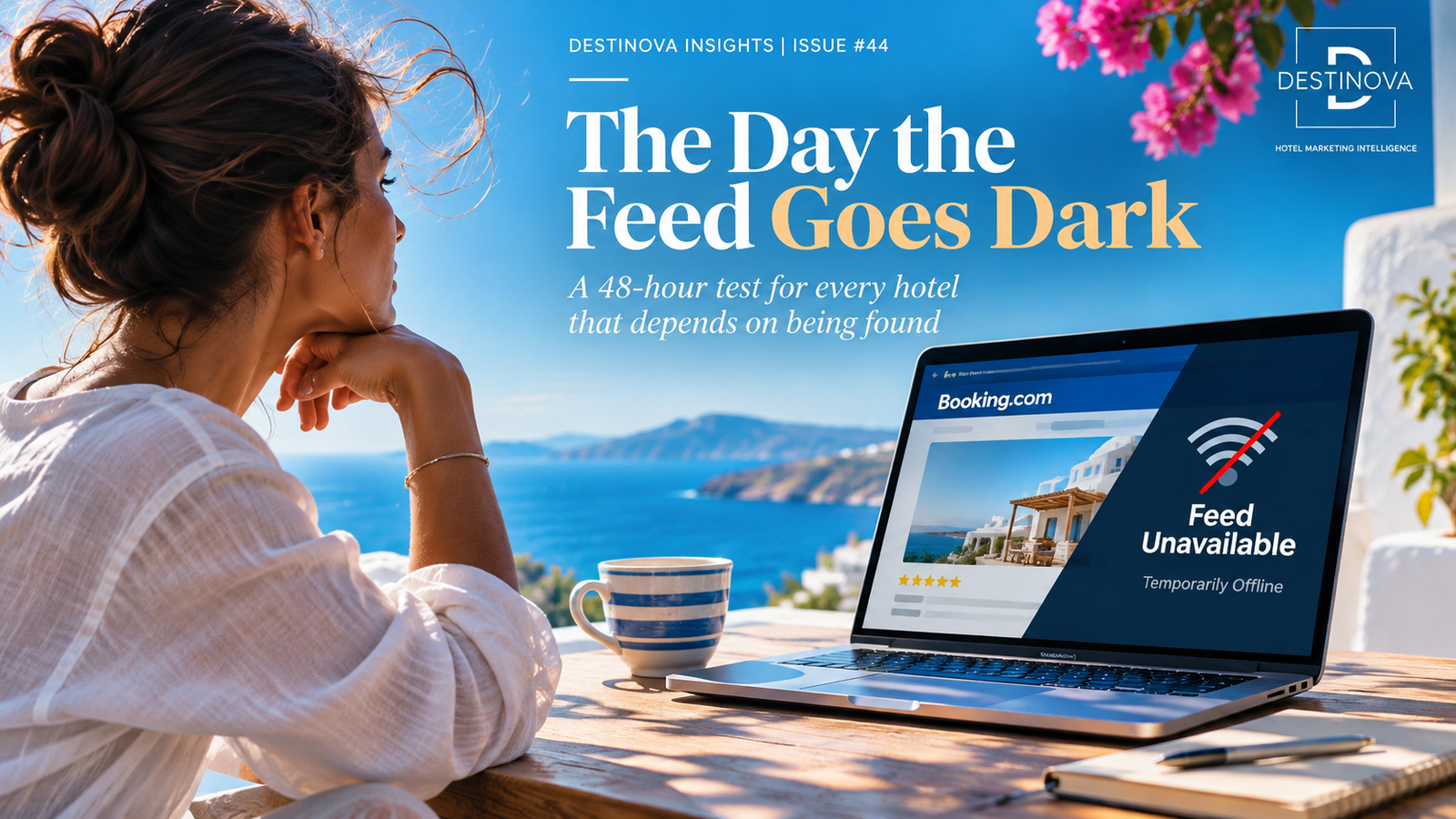
Imagine it happens tomorrow morning.
Every intermediary your hotel depends on goes dark for 48 hours. Not forever. Two days. The listings are there, but nobody can search them, click them or book through them.
Nothing else breaks. Your rooms are the same. Your staff are the same. The sea is exactly where you left it.
The question is simple, and most hotels have never asked it: who would still reach you?
This issue is for hotel owners, general managers and commercial teams who rely on intermediaries to fill rooms. In ten minutes, you'll have a one-page map of where your hotel depends on being found, and one action to take before Black Friday.
This is a thought experiment, not a forecast
It's worth being clear about what this is.
It is not a prediction that anything will go dark. It is not an argument against intermediaries. They do real work, and most hotels would be poorer without them.
It is a stress test. Engineers run them on bridges, not because they expect collapse, but because the only way to know where the weight sits is to take something away.
A hotel's distribution has weight in places nobody has measured. For 48 hours, you find out where.
A hotel isn't tested by how well it is found. It's tested by what happens when the finding stops.
Three kinds of guest
If the feed went dark, your guests would fall into three groups.
The ones who would find you anyway. They know your name. They've stayed before, or a friend has. They would search for you directly, find your site and book.
The ones who would try, and fail. They know your name but have nowhere to go. Your site is slow, or doesn't take the booking, or doesn't look like the place they remembered. They would try a second hotel.
The ones you would never hear from. They were never looking for you. They were looking for "a hotel in Paros under €200," and you appeared. When the feed stops, so does the relationship, because there never was one.
Few hotels know the size of these three groups with any confidence. And understanding how much demand depends on intermediary discovery, rather than existing awareness of the hotel, is the first step towards understanding how much of that demand the brand can generate independently.
The 48-hour test
Five questions. Answer each one without checking, because the point is what you already know.
1. Could a returning guest reach you directly?
Not a website that exists. A route they know, remember and would use. Your own number, your own email, your own booking page.
2. Could you contact them?
Of the guests who stayed this season, for how many do you hold a usable email address? Not a relay address. A real one.
3. Does your own booking page work as well as the feed?
Load it on a phone, with a poor signal. Time it. Count the steps. Would a guest who was already sold complete the booking, or give up?
4. Do you know who is arriving in the next two weeks?
And have you created an appropriate opportunity to communicate with them directly before arrival?
5. Would anyone notice you were gone?
Not your competitors. Your former guests. Is there anyone who would think to ask where you went?
Count the questions you could answer with a confident yes. Don't turn it into a score. Turn it into a map. Wherever you hesitated is where the weight sits.
What the test is not
One more caution, so it stays honest.
The test reveals potential exposure, not wrongdoing. Being present on intermediary platforms is a legitimate commercial decision, and hesitation over any of these questions doesn't mean a hotel is badly run.
Distribution partners provide reach, convenience and access to demand that many properties could not efficiently generate alone.
The point isn't to eliminate that dependence. It's to understand where it exists, how much commercial risk it creates and which parts of the guest relationship the hotel could strengthen itself.
That is the same question Issue #43 asked from the budget side: what share of next season do we intend to sell ourselves, and what does it cost to build it? The 48 hours just make it concrete.
Black Friday is the live version
This is the week many hotels decide on an offer, so it's worth separating two things that look the same.
An offer goes to everyone. It lives in the feed, sits next to every competitor's, and reaches whoever happens to be scrolling. When it ends, so does your connection to everyone who took it.
An invitation goes to people who already know you, through a direct channel where you have an appropriate basis to contact them.
The discount can be exactly the same.
But the difference is what exists beyond the transaction: an established connection, a reason to remember the hotel and, where the guest has agreed to ongoing communication, an opportunity to stay in touch.
The value isn't simply that you have a name.
It's that the name belongs to a relationship worth continuing.
If you've started the winter communication series from Issue #41, you may already have a relevant, permission-based audience to invite.
If you haven't, this is a useful moment to examine what kind of direct guest relationship you can begin building.
A carefully targeted invitation to a few hundred returning guests may reveal more about the strength of your existing relationships than a broad discount campaign measured only by reach.
An offer goes to everyone. An invitation goes to someone.
The exercise
It takes about an hour, and it's best done before the end of the week.
- Answer the five questions on a single page, without checking
- Circle the ones where you hesitated
- For the first circled question, write one action you could take before Black Friday
One action is enough. A test that ends with a list of twelve fixes never gets used.
Where Destinova can help
Our view is simple: a hotel should be chosen by guests who already know it, not only found by guests who happen to be scrolling.
Where we can help is the part of the test about direct contact. We connect Greek hotels with verified, opted-in travelers through email campaigns that lead to the hotel's own booking page, run as a managed service rather than a tool you have to learn.
What we don't do: we don't promise bookings, and we don't replace the intermediaries that already work for you.
If you've done the test and want a second pair of eyes on your answers, book a 20-minute discovery call: https://calendly.com/emistri-adthlos/destinova-discovery-call
Bring the page with the circled questions, and we'll tell you honestly where we'd start, even if the answer is that you don't need us yet.
💬 Worth asking yourself this week
If the feed went dark for 48 hours, how many of the questions could you answer with a confident yes?
And which of your Black Friday offers would be an invitation, not just an offer?