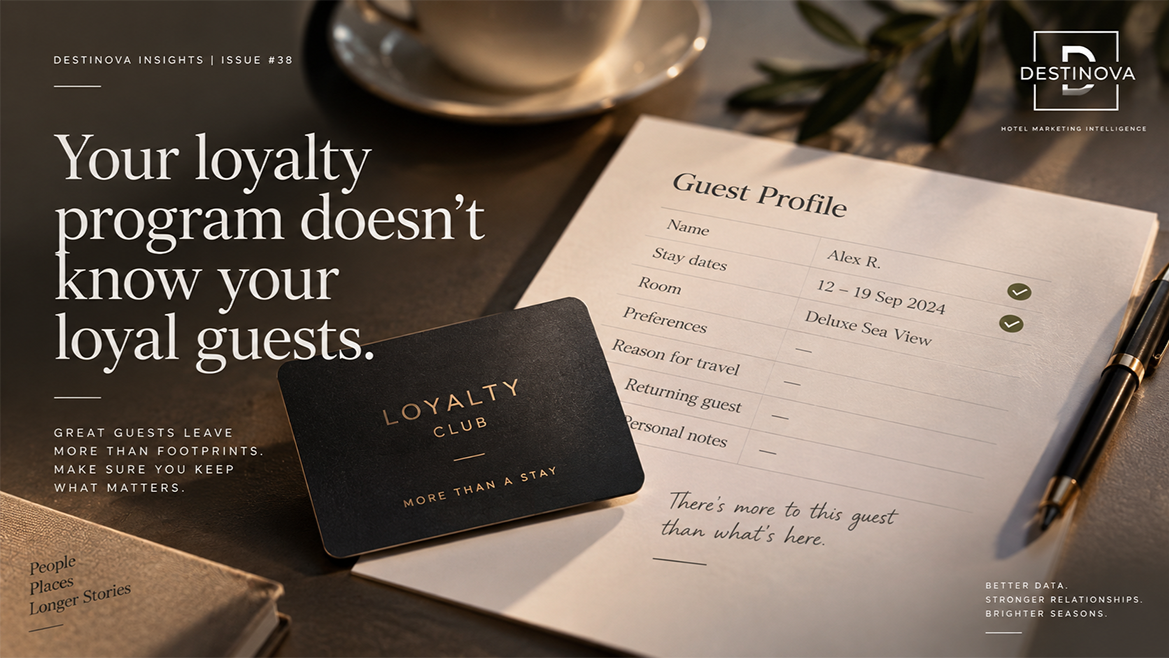
This autumn, loyalty is everywhere.
Cards. Tiers. Points. Member rates. Apps.
Across the industry, properties that spent the summer filling rooms are spending the autumn designing ways to keep the guests who filled them.
The logic is sound. Know your guests. Recognise them. Reward them. Keep them.
But underneath every one of those programmes sits a single assumption, rarely questioned: that you already know who your guests are.
What the database actually contains
Picture check-in at 23:00 in the second week of August. Eight people in the queue. A receptionist in the eleventh hour of a shift. A phone ringing. A family whose transfer was late and whose children are asleep on the luggage.
The system has a field for guest preferences. It stays blank.
There's a field for purpose of travel. It's skipped, or filled with whatever closes the screen fastest.
There's a notes field. Nobody has written in it since June.
Now multiply that moment by every arrival in the season.
And then look at the email addresses. For OTA bookings, many of them aren't the guest's address at all — they're relay aliases issued by the platform. An address you don't own, and in most cases can't use for marketing.
What remains, once you strip away the empty fields, is a name, two dates, a room number, a rate and a channel.
That isn't a guest taxonomy. It's a receipt.
A guest profile with a name, two dates and a room number isn't a profile. It's a receipt.
Why it happens
None of this is laziness. It's structural.
The period when a hotel collects the most guest data is exactly the period when its staff have the least time to collect it properly. Peak season is the worst possible moment to ask anyone to type carefully.
So under pressure, fields get skipped. Under more pressure, they get half-filled. And under the most pressure of all, they get filled with guesses — which is worse than leaving them blank, because a guess looks exactly like knowledge once it's in the system.
Add staff turnover, and the person who actually knows a guest is rarely the person who typed their record.
And because nobody uses the data until the loyalty programme launches, nobody notices it isn't there. The fields exist. That's what creates the illusion.
The field exists in the system. That's exactly what makes it easy to believe the data does.
Where the real knowledge lives
Ask any front office manager who their most loyal guests are, and they'll usually tell you. Just not from the system.
The receptionist knew that the couple in room 12 were on their third year. The waiter knew what the man at the corner table drank, and that he never wanted it asked. The housekeeper knew which family always requested the same room, and why.
That knowledge is real, specific and enormously valuable. It's precisely what a loyalty programme is supposed to be built on.
And almost none of it is in the PMS. It lives in people's heads. And in a few weeks, most seasonal contracts end.
In Issue #34 we wrote about the silent guest — the loyal traveller who never leaves a review and never makes noise. They don't appear in the review data. It turns out they rarely appear in the CRM either.
The only reliable record of them is human. And it walks out the door in October.
What the programme ends up rewarding
A loyalty programme can only reward what its database can see. And a database built on receipts mostly sees one thing: frequency.
So it rewards the business traveller who stays five times a year because the property is close to his client. Convenient, reliable, valuable — but not necessarily loyal in any meaningful sense. The day his client moves, so does he.
And it misses the couple who chose you three Septembers in a row. One stay a year. Booked direct. Never complained, never asked for anything, never appeared anywhere except in the memory of the people who served them.
The programme rewards the guests who were found. It can't see the guests who chose you.
That's not a flaw in the loyalty concept. It's a flaw in what the concept is standing on.
A loyalty programme can only reward what the database can see. And most databases mostly see frequency.
The foundation, before the card
The fix isn't more technology. Most properties already have more system than they use.
It's building the foundation the card assumes is already there.
Run an October debrief before the team leaves. One hour with front desk, F&B and housekeeping. One question: which guests do you remember? Who came back? Who was celebrating something? Who asked for the same thing every time? Write it down while the people who know are still in the building.
Capture at the right moment, not the busiest one. Check-in is the worst time to ask anything. The second morning, or a single question at checkout — what brought you back? — produces better data than any form at the front desk.
Separate what you know from what you assumed. A blank field is honest. A guessed field is misleading. If your system can't mark the difference, keep a separate list of what's been confirmed.
Start with the guests whose contact you actually own. Direct bookers are the ones with real addresses — and, as Issue #36 argued, they're disproportionately the ones who chose you on purpose.
Then build the card.
What this doesn't mean
This isn't an argument against loyalty programmes. The instinct behind them is exactly right. The hotels investing in guest recognition this autumn are asking the correct question.
The problem is sequence.
A loyalty card isn't loyalty. It's a way of recognising loyalty that already exists. And if the hotel can't see the loyalty, the card has nothing to recognise — so it defaults to counting stays, and quietly turns a preference relationship into a points transaction.
Build the knowledge first. The programme will be worth far more once it has something real to stand on.
A loyalty card doesn't create loyalty. At best it recognises it — and only if someone wrote it down.
💬 Worth asking yourself this week
If your seasonal team left tomorrow — what would your guest database actually know about your five most loyal guests?
And who, right now, is the only person who could tell you?