Last week's Issue #38 ended with a problem:
Your team knows more about your loyal guests than your PMS does.
One response raised the question that matters next:
How do you capture that knowledge without creating another administrative task for the team?
That's the whole problem.
Because hotels have tried this before.
They add a field. They circulate a form. They ask the team to log guest preferences at the end of each shift.
And it works for about eleven days.
Every previous attempt failed for the same reason: it was a form. Forms lose to a busy Tuesday.
Why the form always loses
A form asks people to translate what they know into someone else's categories, at the end of a shift, for a benefit they may never see.
It competes with going home.
It will lose that competition almost every time.
And that isn't a failure of discipline.
It's a badly designed ask.
So don't start by designing another system.
Design one conversation, attached to a moment that already exists.
The one hour
Sometime in the next two weeks — before the final day, because by then everyone is already mentally leaving — put front desk, F&B and housekeeping in a room together for one hour.
Don't make it another meeting.
Order some food. Make it part of the end-of-season moment you were probably going to have anyway.
Then ask one question:
Which guests do you remember?
Not tell me about our guests.
Not who were our VIPs?
Just:
Who stuck?
And then let them talk.
Don't ask the team to remember every guest.
Ask them who they still remember.
Because memory has already done the filtering.
If someone remembers a guest six weeks later, after a season of serving thousands, that guest registered for a reason.
You don't need to define the criteria in advance.
The team's recall has already applied them.
Don't ask the team to remember every guest. Ask them who they still remember. Memory has already done the filtering.
What each department actually sees
All three departments need to be in the room because they hold completely different pieces of the same guest.
And often, none of them knows what the others know.
Front desk sees booking behaviour.
Who booked direct.
Who returned.
Who asked about the same dates next year before leaving.
F&B sees rhythm and preference.
Who ate alone and preferred to be left alone.
Who was celebrating something.
Who came down early every morning.
Who always ordered the same thing without looking at the menu.
Housekeeping sees details almost nobody else sees.
Who consistently asked for extra pillows.
Who preferred the room untouched until the afternoon.
Who requested the same room again.
Who left a handwritten thank-you note.
Housekeeping often sees more of the guest's actual habits than almost anyone else in the operation.
And is asked about them the least.
Put those perspectives together and a guest who appears as one line in three separate systems becomes a person.
Housekeeping sees some of the richest behavioural detail in the hotel — and is asked about it the least. That's not a small oversight. It's part of the missing data.
What to write down
One line per guest.
Genuinely one.
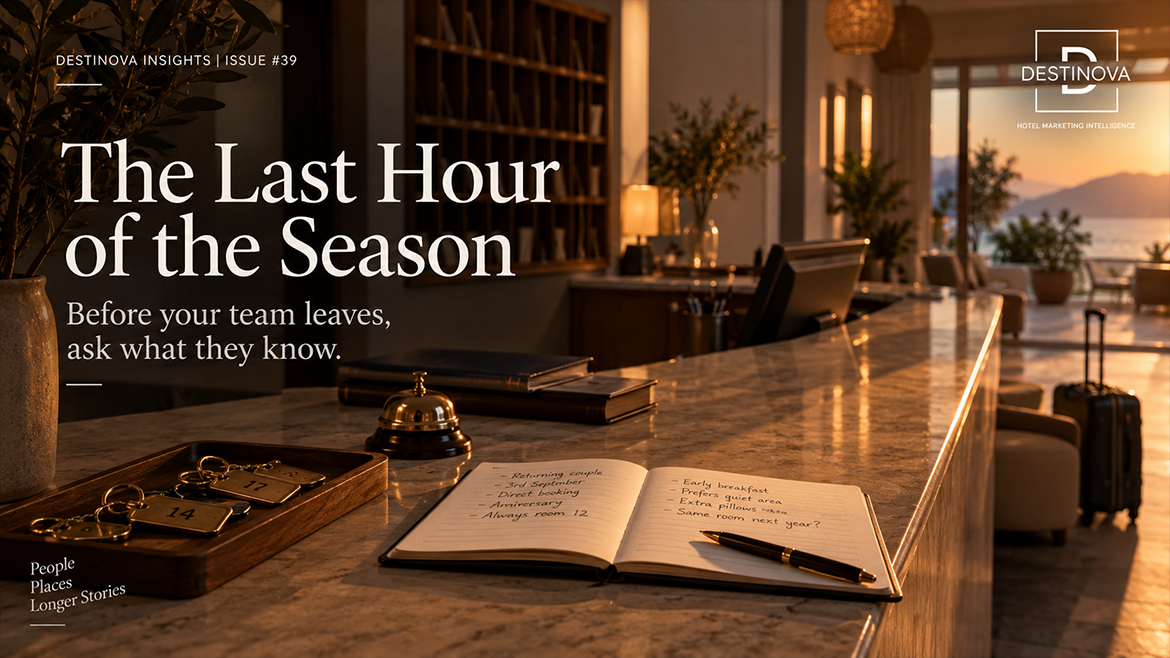
Returning couple. Third September. Direct booking. Anniversary. Always room 12.
That's enough.
That single line can be worth more than a completed profile nobody had time to maintain, because every word came from something the team actually observed.
Write it in the team's own words.
Don't stop the conversation to translate everything into CRM fields and system categories.
That can happen later, if it needs to happen at all.
The moment you turn the exercise into data entry, you risk killing the reason it worked.
And don't try to be complete.
You're not rebuilding the database of an entire season in an hour.
You're creating a shortlist of the guests who mattered.
If you finish with forty names, that's an extraordinary result.
One more thing:
separate what the team knows from what the team assumes.
Confirmed information is useful.
A blank is honest.
A guess stored as fact is worse than either.
What it's actually for
Three things.
And none of them requires new technology.
1. A real follow-up list.
In Issue #37, we argued for staying in contact between October and April.
This is what makes that communication specific instead of generic.
Instead of:
"We hope you enjoyed your stay."
you know who returned for the third September, who celebrated an anniversary, who asked about next year.
The difference isn't automation.
It's recognition.
2. A foundation for the loyalty programme.
If you're building one, you now have something more meaningful than stay frequency.
You have the beginnings of preference, context and intent.
A loyalty programme can start recognising why someone returns, rather than simply counting how many times they did.
3. A pattern you couldn't see before.
Read forty of those lines together.
Something will begin to emerge.
A type of traveller.
A recurring reason for choosing you.
A particular experience people remember.
A behaviour shared by the guests who return.
That's something most hotel reports cannot tell you.
It's positioning — written by the people who actually chose you.
The part that matters most
The hour costs almost nothing.
Not doing it means much of what your team learned this season may leave with them.
And for a seasonal property, that can happen remarkably quickly.
That's the real trade-off.
Not a system versus no system.
Not technology versus intuition.
One conversation versus knowledge quietly disappearing every October.
And unlike most items on the autumn list, this one has a deadline you don't control.
When the team leaves, part of the hotel's memory leaves with them.
In Issue #38, the question was whether your loyalty programme actually knows your loyal guests.
This is where that knowledge starts.
Not with another field in the PMS.
Not with another form.
Not with another piece of technology.
With one hour, before the people who know the answers leave for the season.
💬 Worth asking yourself this week
When does your seasonal team finish?
And is there one hour in the calendar before then when you ask them what they know?