Last week’s Insights argued that hotels fall into two categories: those that are chosen and those that are simply found.
The distinction sounded editorial. It isn’t. It’s a financial statement.
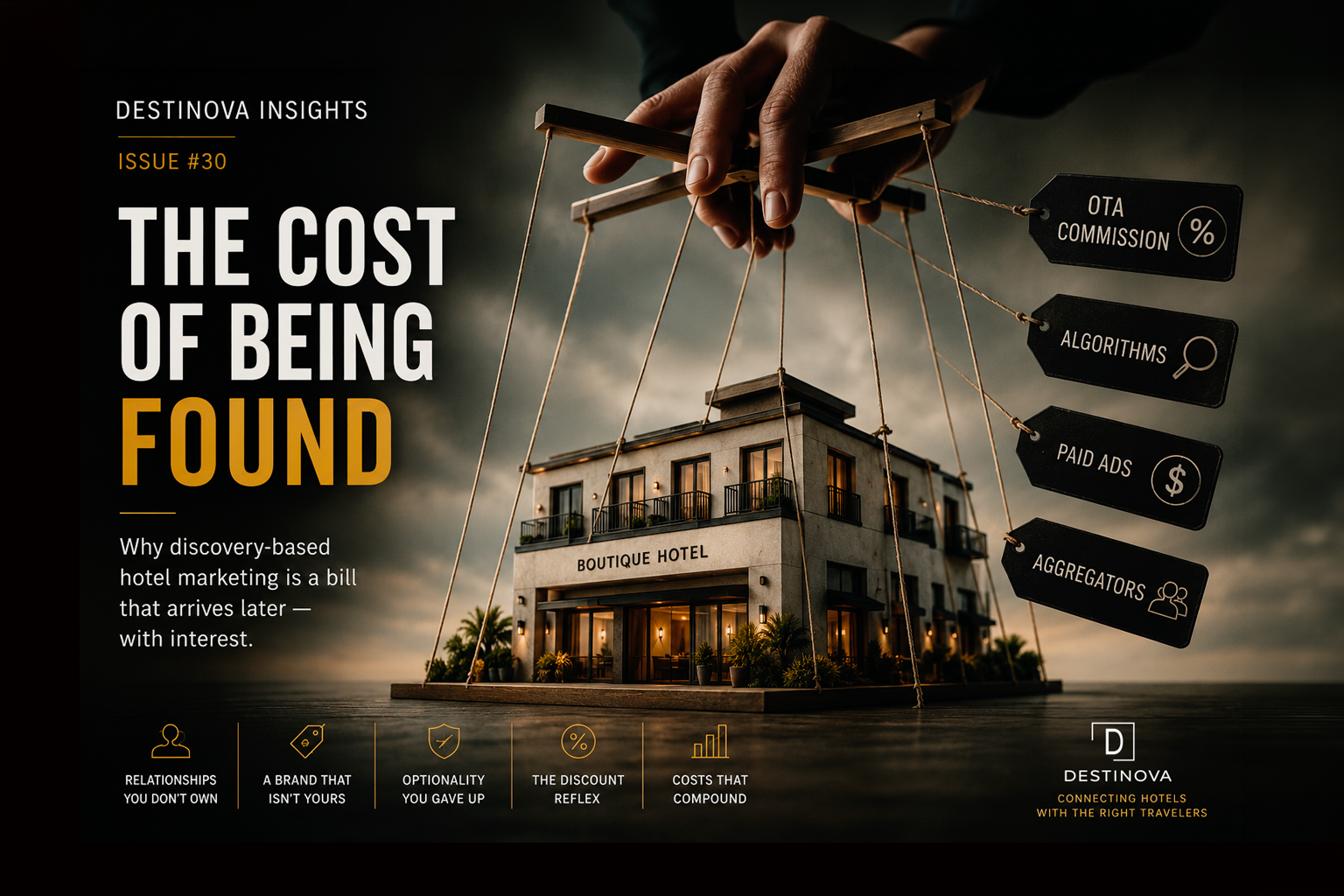
Because being found — through OTAs, algorithms, paid ads, or aggregators — is never free. It just doesn’t invoice you in the way that makes the cost easy to see.
The bill arrives later. Sometimes months later. Sometimes years. And by the time it becomes visible on the P&L, most hoteliers have paid it many times over without realizing what they were buying.
Being found isn’t cheaper than being chosen. It’s just deferred payment — and the interest compounds.
The Visible Cost, and Everything Underneath It
Every hotelier can quote the visible cost of being found. OTA commissions run 15% to 25% per booking. A property doing €2M in OTA-attributed revenue is transferring roughly €300,000 to €500,000 per year to platforms it doesn’t own, to a channel it doesn’t control, on behalf of guests it will never meet again.
Most hoteliers accept this as the cost of doing business. They shouldn’t. Not because the commission itself is unfair — but because the commission is only the surface layer of what discovery-based marketing actually costs. Underneath it are four other bills, each of which most hotels never see clearly.
The First Hidden Cost: The Relationship You Never Owned
When a guest books through an OTA, the OTA owns the relationship. Not the email. Not the preferences. Not the booking history. Not the ability to re-market. Not the trust the guest built after actually staying at your property. The OTA holds the traveler’s data — permanently.
A hotel that welcomes 10,000 OTA guests a year has, at the end of that year, roughly zero incremental audience assets to show for it. No email list. No first-party data. No reactivation potential.
If that same hotel had converted even 30% of those guests into a direct database, it would end the year with 3,000 recoverable guest relationships — an asset that generates bookings for years without further acquisition cost. Instead, that value gets rebuilt from scratch every season. Rented, not owned.
The Second Hidden Cost: The Brand That Isn’t Yours
When a traveler books through an OTA, the OTA is the brand the traveler remembers. They didn’t book “your hotel.” They booked “a stay on Booking.com” or “a place they found on Expedia.”
This has real consequences. The guest doesn’t develop loyalty to your property — they develop loyalty to the platform that surfaced you. Next time they travel, they open the same platform. They see a competitor with a slightly lower rate. They book that instead.
You didn’t lose that traveler because your product was worse. You lost them because you never had them in the first place.
Every OTA booking teaches the traveler that the platform is where trust lives — not your hotel.
The Third Hidden Cost: The Optionality You Gave Up
Being found is a strategy that only works while the discovery layer is stable. The moment an algorithm changes — Google’s search results, Booking’s ranking logic, an OTA’s promotional priorities — a hotel that depends on discovery loses volume overnight. Not because anything changed at the property. Because the machine that was pointing travelers toward it started pointing them elsewhere.
Hotels that rely on discovery have almost no optionality when this happens. Their entire pipeline lives on infrastructure they don’t control. The hotels that survive these shifts are the ones that built demand independent of discovery — guests who would find them even if the algorithm didn’t help.
Optionality has no line item on a P&L. But its absence is the reason many hotels that looked successful for a decade collapsed within eighteen months.
The Fourth Hidden Cost: The Discount Reflex
Being found trains a hotel to compete on the terms the discovery layer sets. Because OTAs rank partly by price competitiveness, hoteliers learn — often unconsciously — to keep rates aggressive, to offer discounts to preserve visibility, to match competitors down rather than differentiate up. Over time, the hotel’s positioning gets shaped not by what makes it distinctive, but by what makes it rank.
This is how properties end up with pricing strategies that reflect the OTA’s incentives instead of their own brand’s value. The cost isn’t just margin lost on individual bookings. It’s the long-term erosion of what the hotel could have charged if it had spent that same energy building demand from travelers who chose it — not travelers who compared it.
A hotel that competes on discovery competes on the algorithm’s terms. A hotel that competes on recognition sets its own.
The Compound Math
Any single one of these costs, in isolation, seems manageable. That’s why they persist. But they don’t operate in isolation. They compound.
A hotel that spends five years operating primarily on being found ends that period with:
- A smaller owned audience than when it started
- A brand that competes with the OTAs that sold it
- A pricing floor set by aggregators, not by positioning
- A pipeline dependent on infrastructure it doesn’t control
- A P&L where 10 to 15 cents of every euro goes to platforms that will keep charging the same next year, and the year after
Meanwhile, a comparable hotel that spent the same period investing in being chosen ends that period with:
- An email database of tens of thousands of qualified travelers
- Direct booking share that grew from 20% to 50%+
- Pricing power set by brand pull, not comparison
- A pipeline that survives platform shifts
- Roughly the same guest volume, at meaningfully higher margin
The two hotels look identical in any given month. Over five years, they become entirely different businesses.
Why This Cost Is So Rarely Named
If the cost of being found is this significant, why do so many hotels accept it? Three reasons, all uncomfortable.
1. The bill is delayed.
OTA commission is visible per booking. The compounding cost of not owning the relationship, the brand, or the optionality only becomes visible over years — long after the strategic decisions have been made.
2. The alternative feels harder.
Being chosen requires investment in positioning, content, audience-building, and brand — work that takes months to produce visible returns. Being found produces bookings this week. Under pressure, most hoteliers choose the fast bill over the compounding one.
3. The industry normalized it.
Every hotel does it. So the true cost gets treated as a fixed reality of the business, rather than a strategic choice being made — and remade — every day. None of these reasons make the cost smaller. They just make it invisible.
You can rent discovery indefinitely. But every euro you spend renting is a euro you didn’t invest in what you could have owned.
What This Actually Changes
For hoteliers reading this, the implication isn’t that OTAs should be abandoned. They’re a legitimate part of a diversified acquisition strategy — and for many properties, the fastest path to filling inventory that would otherwise sit empty.
The implication is different. Every euro spent on being found is a euro that isn’t being invested in being chosen. The question isn’t whether to use OTAs. It’s whether the hotel is treating discovery as a supplement to a chosen strategy — or as a substitute for one.
Hotels that treat it as a supplement grow more valuable each year. Hotels that treat it as a substitute pay the same bill forever.
Worth Asking Yourself
If your OTA share dropped by 30% next month — for reasons entirely outside your control — how much of your business would remain? That’s not a hypothetical scenario. That’s the exact math you’re already carrying, whether you’ve priced it or not.